1a) What do you like and dislike about them? What types of pedals do you find interesting, and that you wish you could learn more about? Try to pick out analog effects and not digital ones.
One major point I dislike it the price of pedals. Just with the $50 we spent on this class for supplies, we have enough to make several pedals. Also, I dislike that it is more uncommon than not to find a completely unique pedal. There are no limitations to what you can make with analog, but you need to be creative and willing to take risks. I really enjoyed the sound of the Space Race pedal by Alexander, though regardless of its $200 price tag, it is nothing I haven’t heard before. I am glad most of these pedals have a range of options to tweak the sound.
1b) Can you describe any overall differences in approach that you see in what bigger companies (Boss, MXR, Ibanez, TC Electronics) are making, and what smaller “boutique” companies (for example – Death By Audio, ZVex, Fairfield Circuitry, Walrus Audio, T-Rex) are making?
With boutique companies, I notice many of them are all hand-made. Bigger companies are mass producing, and therefore have machine-made products. Also I notice slightly more risk being placed in what the “boutique” companies manufacture, as they tend to take more creative liberties to stand out from the other brands.
1c) The possibilities for guitar pedals and analog effects are literally endless. See if you can find a pedal that has a sound, controls, or features that are undeniably different from anything else. Post a link, photo, or video demo of it and explain what’s unique about it.
ZVex Super Seek Trem:
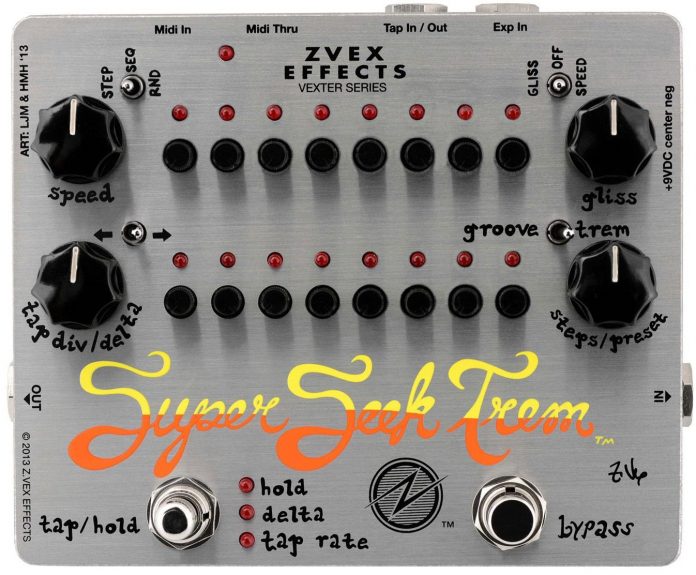
The ZVex Super Seek Trem allows the user to create unusual rhythmic patterns, MIDI sync, tap tempo, and provides expression control over speed and glissandos (as well as many other things).
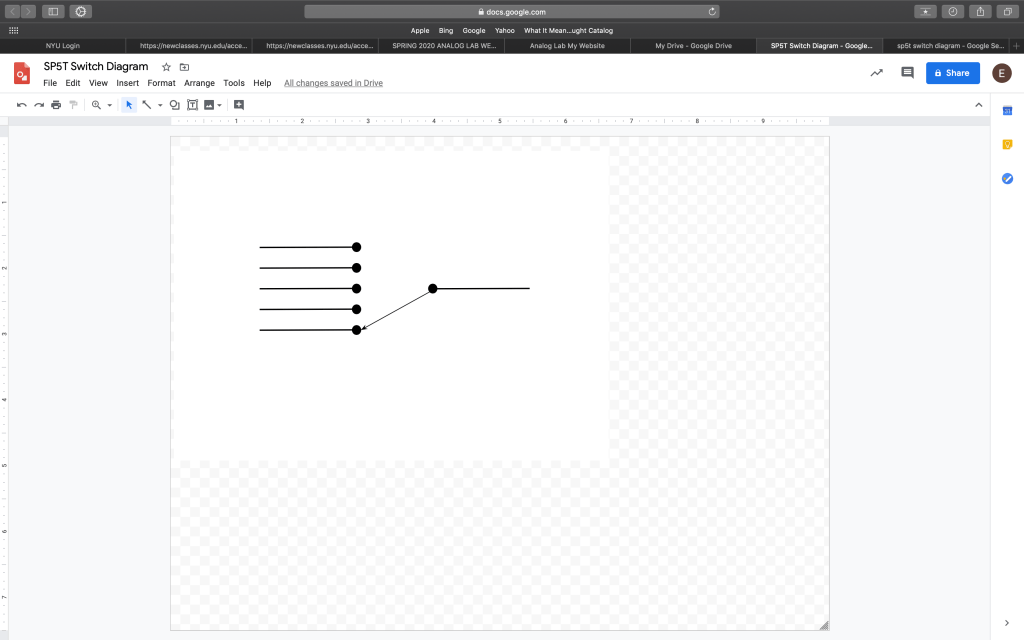
2) Draw a diagram for a SP5T switch. What kind of switch is this?
A SP5T switch is a “single pole, five throw” switch, which means that there is one pole that can connect to five different parts of the circuit.
3) Explain the difference between a momentary button vs a latching button. What kind of application could you use each type for?
A momentary button is a type of switch that only connects the two pins together when the button is being held down. It stays in its “on” state for as long as you hold it This can be used for keys on musical instruments to play different notes. A latching button is a type of switch that keeps the two pins connected even after you release it, and until you manually turn it off. This type of button is popularly used for effect pedals.
 Emily Dykhouse Analog Lab